
Scaling Beyond Capacity
Building a Sustainable Creative Organization Through Strategic Expansion
The Challenge
The Conferences & Events team was a multidisciplinary creative organization operating across the United States, Costa Rica, and Poznań, Poland. Despite strong performance and consistent demand, the team faced a growing operational risk: sustained utilization above 90%.
While high utilization can appear favorable in performance reporting, maintaining that level over an extended period creates significant challenges. Limited available capacity increases the risk of employee burnout, restricts flexibility, and makes it difficult to absorb fluctuations in demand.
As a member of the Core Leadership Team responsible for the organization, I recognized that the existing operating model was becoming unsustainable.
Simply increasing headcount could reduce immediate pressure, but it also carried a risk. If demand subsequently declined, the team could move from overutilization to underutilization.
The challenge was to create a more sustainable organization without introducing unnecessary long-term capacity risk.
Developing the Strategy
As part of an organizational model I had previously established, the Conferences & Events team operated with a Core Leadership Team and a Tactical Team, providing complementary perspectives on strategy and day-to-day execution.
Rather than assembling a new leadership structure to address the utilization challenge, I activated the existing model. The Core Leadership Team, representing Creative Direction, Operations, Shift Management, Workflow Planning, and Account Management, led the strategic evaluation, supported by operational data and insights from the Tactical Team.
Together, we examined current workloads, historical demand patterns, available capacity, and opportunities to expand the team's capabilities.
A critical source of information was our workflow planning process, which tracked not only completed work but also requests the team had been unable to accept because it lacked the necessary expertise.
These requests were being redirected to other teams, creating a documented record of historically unmet demand.
Rather than expanding solely against existing workloads, we developed a strategy that addressed both capacity pressure and opportunities for growth.
The analysis supported introducing Motion Design and UI/UX capabilities alongside the team's established services.
Designing Flexibility Into the Expansion
Expanding into new disciplines introduced another strategic risk.
Because previously unmet requests had been redirected elsewhere, there was no guarantee that the work would immediately return once the new capabilities became available. Client relationships and established workflows might already have shifted to other teams.
To protect against this possibility, we established an important hiring requirement: new colleagues needed to possess the core creative capabilities required to support the team's existing services, in addition to their Motion Design or UI/UX expertise.
This approach allowed the expanded team to support established demand while developing new service offerings.
Rather than creating isolated pools of specialists, we built operational flexibility into the team's structure.
Implementing a Phased Expansion
With the expansion strategy established, the Tactical Team played a central role in implementation, particularly onboarding and mentoring new colleagues.
Because the organization was already operating above 90% utilization, the colleagues responsible for integrating new hires had limited available capacity. Bringing everyone onboard simultaneously could have increased pressure on the very people the expansion was intended to support.
Rather than imposing an implementation schedule, I sought input from the Tactical Team about the pace they could realistically sustain.
Based on that input, we implemented the expansion in two waves, each representing approximately 50% of the planned growth.
This approach balanced the need to relieve capacity pressure with the practical requirements of integrating new colleagues successfully.
Measuring and Governing the Transformation
Before the expansion, I had developed a KPI dashboard to monitor the team's operational performance.
For the transformation, I introduced additional reporting views to measure three distinct populations:
Existing Team: Tracked whether the expansion was relieving pressure on the original organization.
New Colleagues: Monitored utilization and integration as incoming team members became established.
Full Organization: Provided a consolidated view of overall performance and operational health.
These dashboards served a purpose beyond reporting results.
They were designed to provide actionable information between the two implementation waves. If the first phase failed to produce the anticipated improvements, we could identify the problem and adjust the strategy before proceeding with the second phase.
This prevented the organization from becoming committed to a predetermined expansion plan regardless of its effectiveness.
By combining operational data with feedback from the people responsible for implementation, we established a controlled approach to organizational growth.
The Results
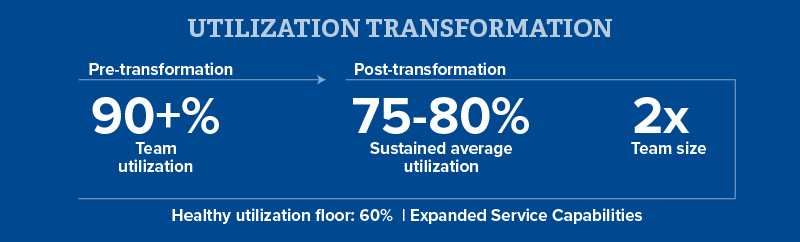
2× Team Growth: The Conferences & Events organization doubled in size, increasing capacity while adding Motion Design and UI/UX capabilities.
75–80% Sustained Utilization: Overall team utilization stabilized within a healthier operating range, down from sustained levels above 90%.
Improved Existing-Team Utilization: Within a few months of completing the transformation, utilization among the original team members had settled into a sustainable range.
Successful Integration: Utilization among new colleagues progressively approached the levels of established team members, providing evidence that the expanded organization was functioning as intended.
Expanded Service Capabilities: The team gained the ability to support additional creative disciplines while retaining the flexibility to meet demand for its established services.
Leadership Insights
Sustainable growth requires more than adding resources to meet immediate demand.
An effective expansion strategy must account for changing workloads, the operational capacity required to integrate new colleagues, and the possibility that anticipated demand may not materialize as expected.
Equally important, implementation plans should include opportunities to evaluate results and adjust course before making further commitments.
An effective organizational structure should enable different solutions, not dictate the same solution to every problem. By establishing complementary strategic and tactical leadership functions, I created a framework that could be activated to address changing operational needs, while preserving the flexibility to adapt each response to the circumstances.
The objective wasn't simply to make the team larger. It was to make the organization more capable, adaptable, and sustainable.