
Designing Risk Out
Restoring Operational Performance Through Data Visibility, Systems Integration, and Preventive Compliance Controls
The Challenge
Designers supporting secure government engagements operated under strict compliance requirements, including restrictions prohibiting certain assignments associated with countries designated by the government.
When demand from government engagements was insufficient to maintain healthy utilization, these designers supplemented their workloads by accepting assignments from the global production queue.
A compliance finding revealed a significant vulnerability in this arrangement.
Although the scheduling system identified each assignment by its charge code, it did not provide workflow planners with the country-of-origin information necessary to determine whether the assignment was permissible.
As the leader of Risk within my function, I recognized that the existing process could expose the organization to compliance violations.
On my recommendation, we suspended the practice of assigning these designers work from the global queue until a reliable safeguard could be established.
This addressed the immediate compliance exposure but created another operational problem. Government-related demand alone was insufficient to maintain healthy utilization, leaving specialized creative resources underutilized.
The challenge was to restore access to eligible global work without compromising compliance requirements.
Phase 1: Restoring Operations Through Data Visibility
Our scheduling environment relied on a centralized database containing extensive information about clients and engagements.
This database served as a shared source of truth for multiple functions, including Graphics, Account Coordination, Workflow Planning, Legal, Contracts, and Finance.
Although workflow planners could see charge codes, much of the underlying client information was restricted and unavailable through their standard scheduling interfaces.
I had independently requested expanded access to the database because I wanted to better understand the information available across the organization and explore opportunities to develop more effective operational dashboards.
I had also invested in learning Power BI, recognizing its potential to improve reporting and decision-making beyond the tools traditionally associated with my role.
Those investments became valuable when the compliance issue emerged.
I believed the country-of-origin information already existed within the database, even though it wasn't visible to workflow planners. After researching the underlying data, I located the relevant information.
Using Power BI, I developed a dashboard identifying engagements associated with restricted countries and presenting only the information necessary for workflow planning decisions.
This provided a practical way to distinguish eligible assignments from restricted work without exposing the broader database to additional users.
The solution allowed designers to resume accepting permissible assignments from the global queue.
Utilization recovered immediately following implementation, resolving the original operational problem while maintaining the necessary compliance safeguards.
However, I recognized that the solution was not suitable as a permanent control.
Phase 2: Eliminating Manual Dependencies
Although the initial dashboard restored operational performance, I identified two significant weaknesses.
Single-Person Dependency: Maintaining the dashboard required specialized database access, Power BI access, and technical knowledge that I alone possessed within the team. The solution depended on my continued availability and involvement.
Data Freshness: The dashboard relied on manually extracted information. If I refreshed the data at 9:00 a.m. and a new restricted-country engagement was created at 9:01 a.m., that engagement might remain absent from the dashboard for nearly 24 hours.
For general operational reporting, a daily refresh might be acceptable. For a compliance-sensitive scheduling decision, the delay introduced unnecessary risk.
I made these limitations clear to stakeholders and began investigating whether the scheduling application itself could provide the necessary information.
My research and discussions with the system's developers confirmed that the existing software did not support the customized views we needed.
Working in my capacity as the leader of Risk within my function, I collaborated with the broader Risk department to request customizable scheduling views as an enhancement to the application.
When the software update was implemented, I configured a new view that displayed country of origin as the first column, making the information immediately visible to workflow planners.
Unlike the Power BI workaround, the customized view drew directly from the scheduling system and updated automatically as new engagement codes entered the database.
This eliminated the manual refresh process and the dependency on my specialized reporting access.
The compliance information was now integrated into the planners' existing workflow, rather than maintained through a separate reporting tool.
The solution was more reliable, current, and sustainable.
But one remaining vulnerability persisted: the system still depended on individual planners recognizing restricted engagements and avoiding inappropriate assignments.
Phase 3: Preventing the Error Before It Could Occur
When I subsequently assumed leadership responsibility for the Canadian team, we strategically separated the leadership of Risk and Compliance.
I continued leading Risk, but Compliance was no longer part of my direct responsibilities.
The Canadian team was unfamiliar with the scheduling system, so I invested additional time in understanding its capabilities to better support their operations.
During that process, I discovered that customized scheduling views could do more than display information. They could also filter assignments out of the available scheduling queue.
This presented an opportunity to eliminate the remaining human-error exposure in the compliance process.
Rather than relying on workflow planners to identify restricted-country engagements and avoid assigning them, I developed a filtered view that excluded those engagements entirely.
Under the new configuration, planners scheduling the affected designers could not see or select restricted-country bookings through their assigned workflow.
The control no longer depended on a planner remembering a restriction, noticing a country-of-origin indicator, or correctly interpreting the information.
The prohibited scheduling option was removed from the workflow itself.
Although I was no longer directly responsible for Compliance, I recognized that this improvement could strengthen the organization's risk controls and implemented the solution.
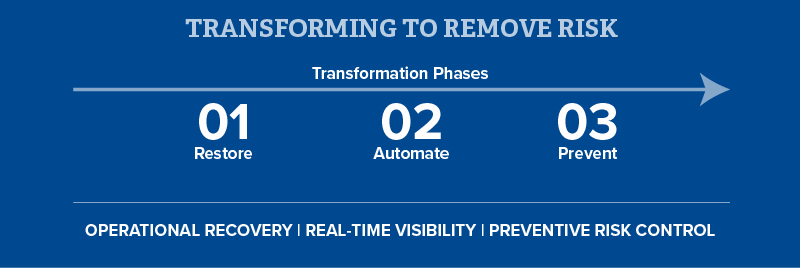
The transformation had progressed from making risk visible to preventing the prohibited action within the scheduling process.
The Results
Immediate Utilization Recovery: The initial Power BI solution restored access to eligible global assignments, allowing the affected designers to return to healthy utilization without reopening the original compliance exposure.
Three-Phase Risk Reduction: The process evolved from manual identification of restricted engagements to automatically updated information and ultimately to a preventive scheduling control.
Eliminated Manual Reporting Dependency: Custom views within the scheduling application replaced a dashboard that required my specialized access, technical expertise, and manual data refreshes.
Current Compliance Information: Country-of-origin information became available directly within the scheduling system as new engagement codes were created, removing the potential delay associated with daily data extraction.
Preventive Scheduling Protection: Restricted-country assignments were excluded from the relevant workflow planners' scheduling views, preventing accidental selection through that process.
Sustainable Operational Flexibility: Designers retained access to permissible global work while the scheduling process incorporated increasingly reliable compliance safeguards.
Leadership Insights
An effective solution to an immediate business problem is not necessarily a sustainable long-term solution.
The first phase of this transformation restored utilization and addressed the urgent operational challenge. From a performance perspective, the problem appeared resolved.
But the underlying process still contained risks associated with manual intervention, delayed information, and dependence on specialized individual expertise.
The second phase demonstrated the importance of integrating critical controls into the systems people already use. By moving country-of-origin information into the scheduling application, we reduced complexity and improved the reliability of decision-making.
The third phase reinforced an even more important principle: whenever possible, preventive controls should be designed into the workflow rather than relying exclusively on people to recognize and avoid prohibited actions.
This transformation also demonstrated the value of continuously developing technical knowledge and looking for improvements beyond immediate responsibilities. My understanding of the underlying database, Power BI, and scheduling application enabled solutions that would not have been apparent from the standard operational interfaces.
And the final improvement emerged after Compliance was no longer part of my direct leadership responsibilities, reinforcing my belief that organizational boundaries should clarify accountability without limiting opportunities to improve the broader business.
The objective wasn't simply to help people make the right scheduling decisions. It was to design a system that removed the wrong decisions from their available options.
Next Transformation Case Study Coming Soon! →